FlatCAD: Fast Curvature Regularization of Neural SDFs for CAD Models

Pacific Graphics 2025 logo

Pacific Graphics 2025 Journal Paper (Computer Graphics Forum)

Equal Contribution
1New Jersey Institute of Technology, 2Warsaw University of Technology, 3IDEAS NCBR, 4IDEAS Research Institute

Teaser image

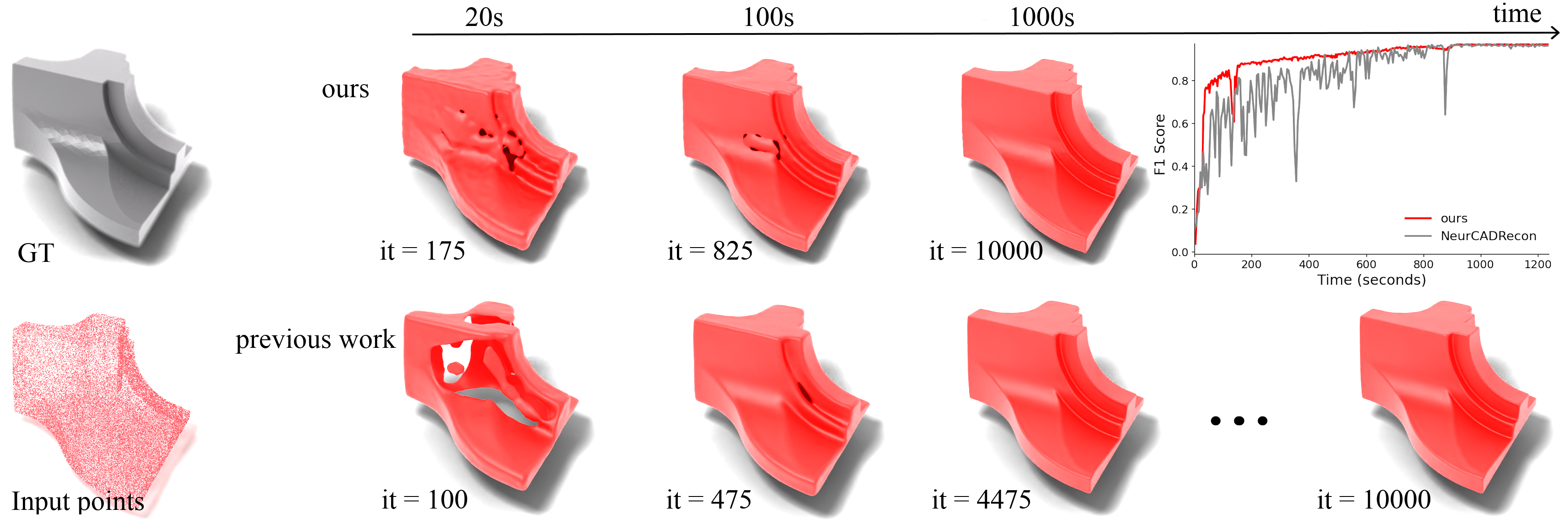
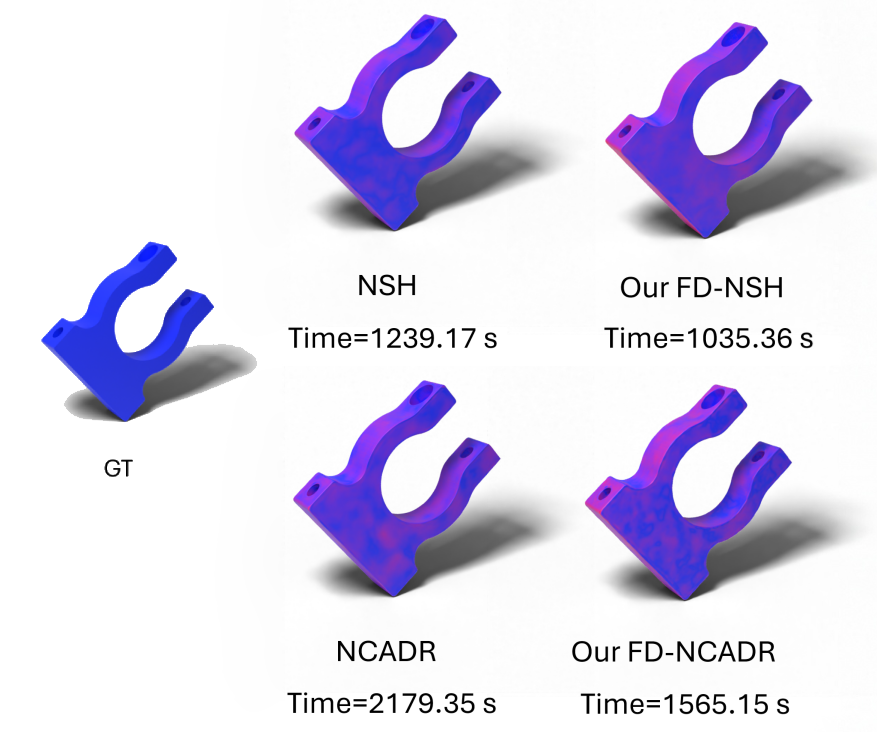
FlatCAD reconstructs point cloud data faster then current state-of-the-art methods with similar quality.

Abstract

Neural signed-distance fields (SDFs) are a versatile backbone for neural geometry representation, but enforcing CAD-style developability usually requires Gaussian-curvature penalties with full Hessian evaluation and second-order differentiation, which are costly in memory and time.

We introduce an off-diagonal Weingarten loss that regularizes only the mixed shape operator term that represents the gap between principal curvatures and flattens the surface. We present two variants: a finite-difference version using six SDF evaluations plus one gradient, and an auto-diff version using a single Hessian-vector product. Both converge to the exact mixed term and preserve the intended geometric properties without assembling the full Hessian. On the ABC benchmarks the losses match or exceed Hessian-based baselines while cutting GPU memory and training time by roughly a factor of two. The method is drop-in and framework-agnostic, enabling scalable curvature-aware SDF learning for engineering-grade shape reconstruction.

Qualitative Results

We evaluate our method on a subset of the ABC Dataset containing CAD shape models. We compare to previous methods like DiGS, NeuralSingularHessian and NeurCADRecon. We find that our method achieves similar reconstruction quality to the state-of-the-art results but shortens both the per-iteration training time and the number of iterations to converge.

(a) Input, (b) Advection (conservative), (c) Diffusion (conservative), (d) Gaussian noise (non-conservative)
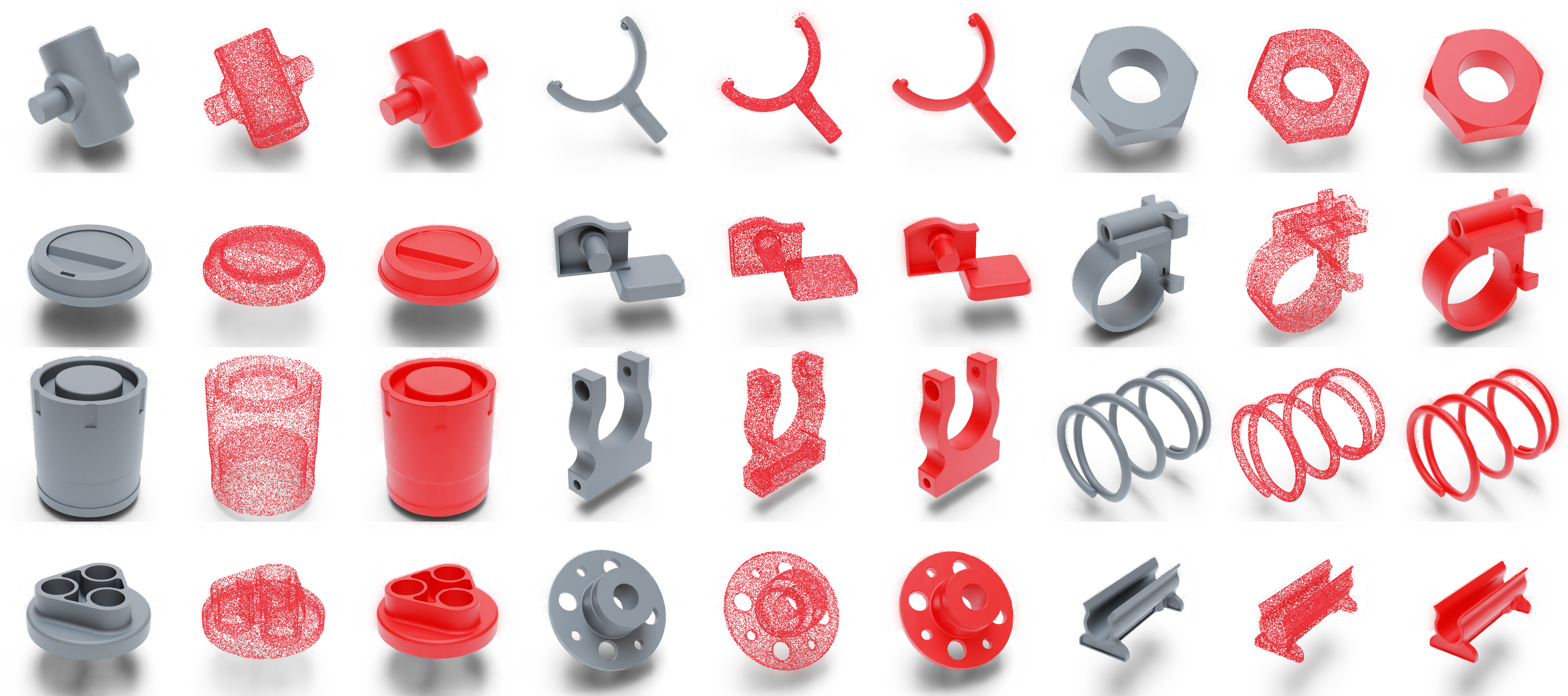
ABC Dataset point cloud reconstruction visualizations. From the left; ground truth mesh visualization, sampled from the ground truth mesh input point cloud visualization and mesh visualization achieved by using marching cubes on the reconstructed Singed Distance Field.

BibTeX

@article{flatCAD2025,
    journal = {Computer Graphics Forum},
    title = {{FlatCAD: Fast Curvature Regularization of Neural SDFs for CAD Models}},
    author = {Yin, Haotian and Plocharski, Aleksander and Wlodarczyk, Michal Jan and Kida, Mikolaj and Musialski, Przemyslaw},
    year = {2025},
    publisher = {The Eurographics Association and John Wiley & Sons Ltd.},
    ISSN = {1467-8659},
    DOI = {10.1111/cgf.70249}
}